

Phoenix Rent Prices in 2026
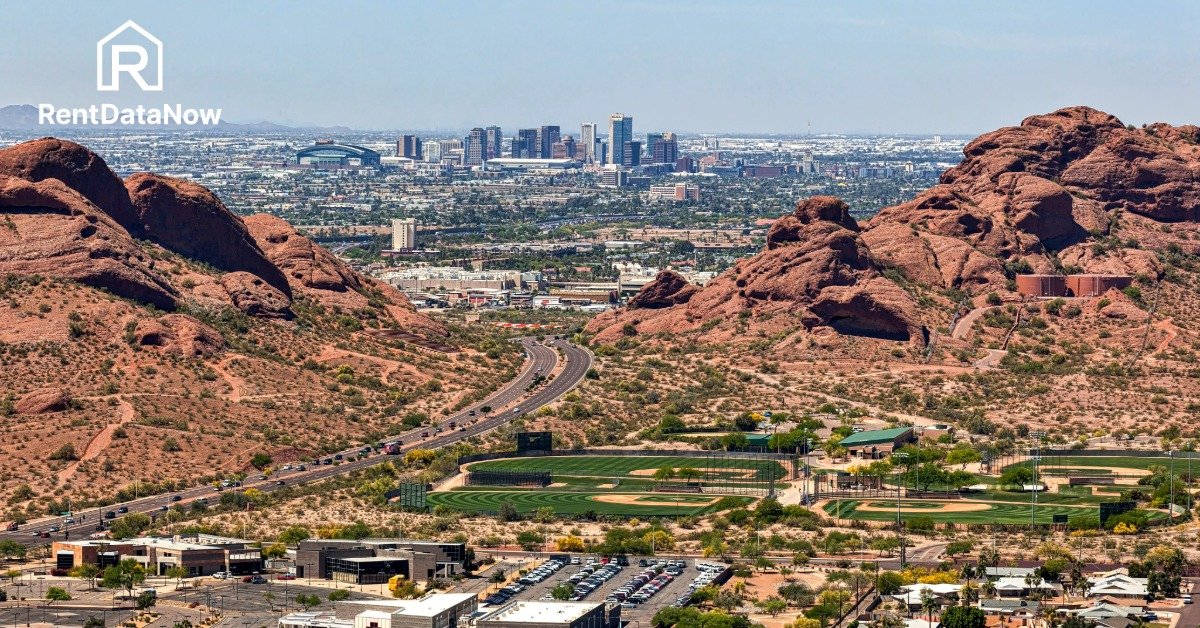
Phoenix's median rent is $1,567 a month as of March 2026, down 0.82% year over year. For a city that was one of the fastest-appreciating rental markets in the country between 2020 and 2022, that decline matters. The pandemic migration wave that drove Phoenix rents up by double digits in a single year has largely played out, supply caught up with demand, and the market has settled into something closer to equilibrium. Whether that holds through the rest of 2026 depends on how much of the new inventory gets absorbed and whether the next wave of Sun Belt migration has any momentum behind it.
Here is what renters are actually paying across Phoenix and the surrounding metro right now, broken down by bedroom size, neighborhood, and how the city compares to its suburbs.
Phoenix Rent by Bedroom Size
All figures are from RentDataNow's Phoenix rent data and reflect March 2026 medians.
Studios in Phoenix average $1,128 a month. One-bedrooms come in at $1,237. Two-bedrooms average $1,439, three-bedrooms $1,940, and four-bedroom units $2,181. The jump from a two-bedroom to a three-bedroom is the steepest proportional increase on the scale, which reflects the relative scarcity of larger family-sized rentals in a market dominated by apartment complexes built around one and two-bedroom floorplans.
For a two-income household each earning close to Phoenix's median, a two-bedroom at $1,439 represents a genuinely manageable housing cost. That's the part of the Phoenix story that gets underreported relative to the attention the 2021 and 2022 rent spikes received.
How Phoenix Compares to Its Suburbs
The Phoenix metro is large enough that where you rent within it matters significantly for both price and lifestyle. The suburbs range from Glendale, which undercuts Phoenix proper, to Gilbert and Scottsdale, which are in a different tier entirely.
Glendale is the most affordable major suburb at $1,528 a month median, with one-bedrooms at $1,206 and rents down 2.2% year over year, the steepest decline in the metro. The median household income in Glendale is $73,530, lower than Phoenix's $81,332, but the rent discount more than compensates. The rent-to-income ratio in Glendale is 25%, still inside the 30% threshold.
Tempe sits at $1,683 a month, up slightly from Phoenix proper, with one-bedrooms at $1,332. It runs at 25% rent-to-income on a $79,663 median income. Tempe's proximity to Arizona State University keeps rental demand consistent and makes vacancy rates lower than most of the metro, which is part of why it hasn't seen the same rent softening as Glendale.
Chandler comes in at $1,862 a month with a 21% rent-to-income ratio, the second best in the metro, driven by a $108,095 median household income anchored by the semiconductor and tech manufacturing cluster around the Intel and TSMC campuses. One-bedrooms average $1,474. Rents there are down 0.3% year over year.
Gilbert is the most expensive suburb at $2,051 a month median, but also has the highest incomes: $122,551 median household, producing a 20% rent-to-income ratio. One-bedrooms average $2,240, which is higher than the median, suggesting the rental stock in Gilbert skews toward larger units. It's a family-oriented suburb with strong schools, and the renter profile reflects that.
Scottsdale sits at $2,131 a month, with a $110,886 median income and a 23% ratio. One-bedrooms average $2,163, two-bedrooms $2,512. Rents grew 2.8% year over year, the strongest growth in the metro, which reflects Scottsdale's ongoing appeal as a destination for higher-income transplants and the relative supply constraints in its denser central districts.
For a direct side-by-side on any two of these cities, the RentDataNow compare tool pulls live data for both.
Phoenix Rent vs. the National Picture
Phoenix's $1,567 median rent sits well below cities it gets regularly compared to. Miami is at $3,001. Los Angeles is at $2,753. Austin, which absorbed similar pandemic migration pressure, is at $1,542, nearly identical to Phoenix despite a significantly higher median income. Denver is at $1,826. Seattle is at $2,193.
The cities that genuinely undercut Phoenix are mostly Midwest and mid-South markets: Indianapolis at $1,374, Memphis at $1,247, San Antonio at $1,360. But those cities don't have Phoenix's labor market depth or its population growth trajectory. For renters who need to be in a Sun Belt metro with a real job market, Phoenix's combination of rent level and income base is hard to beat in its tier.
The rent-to-income ratio of 23% means the median Phoenix household can rent the median Phoenix apartment and stay comfortably under the 30% threshold with money left to save. That's not true in most comparable metros. Miami's ratio is 58%. Los Angeles is 40%. Austin is 20% but incomes there are significantly higher. Phoenix is delivering something relatively rare: a large, growing, warm-weather city where the math still works for a normal salary.
What's Driving Rent in Phoenix Right Now
The year-over-year decline of 0.82% reflects a market that built aggressively during the 2020 to 2023 demand surge and is now working through that inventory. Multifamily construction completions in the Phoenix metro hit record levels in 2023 and 2024, and that supply is still being absorbed. When vacancy rates rise, landlords compete on price and concessions rather than raising rents. That's the current dynamic.
The question for the rest of 2026 is whether demand can keep pace with what was built. Phoenix's population growth has been consistent and the job market, particularly in semiconductors, logistics, and healthcare, continues to attract workers. If absorption stays strong, the current rent softness is a temporary correction rather than a sustained decline. If demand cools or more supply comes online, further softening is possible.
Month over month, Phoenix rents ticked up 0.71% in March 2026 after several months of flat or negative readings. That's a single data point, but it suggests the market may be finding a floor.
Finding a Rental in Phoenix
The median figures above are starting points, not guarantees. A one-bedroom in central Phoenix or the Arcadia neighborhood will run above the $1,237 metro median. A one-bedroom in Laveen or the far West Valley will likely come in below it. The bedroom breakdown and neighborhood data for Phoenix are available on the Phoenix rent page, including the affordability calculator that lets you run your specific salary against Phoenix's current rent levels.
Frequently Asked Questions
What is the average rent in Phoenix in 2026?
Phoenix’s median rent is about $1,567 per month as of March 2026, slightly down year over year after the pandemic surge.
Is rent in Phoenix going down right now?
Yes, slightly. Rents are down around 0.8% year over year due to increased housing supply catching up with demand.
Is Phoenix an affordable city for renters?
Relatively, yes. With a rent-to-income ratio around 23%, Phoenix is more affordable than many major metros like Miami or Los Angeles.
Related Rent Guides

The typical renter now pays more each month than the typical homeowner
Since 2021, the typical US renter has paid more for housing each month than the typical homeowner, Census data shows. In Philadelp…

Income rose faster than Rent in 14 large US cities
Household income grew faster than rent in 14 large US cities in the latest year both datasets cover. The list is dominated by Sun…
Fair Market Rent (HUD) isn't the Market Rate, and in Phoenix it's 29% Higher
In Phoenix the HUD-derived two-bedroom figure runs about 29% above actual market rent, while in New York it runs about 27% below.…

Jennifer Han is the editor in chief of RentDataNow, covering rent trends, housing costs, and more. She was a real-estate agent before she moved to writing about the market.
Comments (0)
Sign in to join the discussion
No comments yet. Be the first to share your thoughts.