

Rural rent is 41% cheaper than metro rent, and the gap is growing
Renters in rural counties pay a typical $914 a month, 41% less than the $1,553 in metro areas. Metro rent rose faster between the last two Census surveys, and in Wyoming and North Dakota the rural discount nearly disappears. Every state is listed.
Renters in rural America pay a typical $914 a month, 41% less than the $1,553 renters pay in metro areas, according to the Census Bureau's American Community Survey for 2020 through 2024. Those are gross rents, so they include any utilities the tenant pays, and they cover all 3,137 US counties with a rent estimate.
The gap has grown. Between the 2015-2019 survey and the 2020-2024 survey, typical metro rent climbed 32% from $1,176, while rural rent rose 23% from $740. That pushed the rural discount from 37% to 41%. Rural rent outpaced metro rent in only three states: Alaska, Hawaii, and Iowa.
Cheaper rent hasn't made rural renting easy. Rural incomes are lower too, so the typical rural renter household still spends 28.1% of its income on rent, compared with 31.1% in metro counties. In six states, Arkansas, California, Delaware, Louisiana, Massachusetts, and Washington, rural renters spend a bigger share of their income on rent than metro renters do.
Wyoming has one of the smallest rural discounts in the country. Its 21 rural counties average $998 a month, just 9.4% below the $1,101 in its two metro counties: Laramie County, home to Cheyenne, and Natrona County, home to Casper. Only Alaska's gap is narrower. Rural renting also matters more in Wyoming than anywhere else, since 68% of the state's renter households live outside those two metro areas, the highest share of any state.
Teton County, which includes Jackson, pulls the rural figure up. Rent there averages $1,904, 64% more than Laramie County's $1,160, after jumping 38% between the two surveys. Leave Teton out and Wyoming's other rural counties average about $911, which is 17% below the metro counties. Sublette County, at $1,209, also costs more than Cheyenne's county. At the cheap end, Niobrara County, home to Lusk, averages $605. Albany County, where the University of Wyoming sits in Laramie, has the state's heaviest rent burden at 30.8% of income, a pattern that's common in college counties where many renters are students with little income.
In North Dakota, rural rent averages $870, 11.8% below the $986 metro figure, and the state's priciest rentals are in oil country rather than its cities. McKenzie County, home to Watford City, averages $1,284, and Williams County, home to Williston, averages $1,123. Both cost more than Cass County, home to Fargo, at $958, and Burleigh County, home to Bismarck, at $998. Rolette County, on the Canadian border, has the lowest rent of any rural county in the country with at least 1,000 renter households, at $505.
Elsewhere in the region, rural renters save more. Nebraska's rural counties average $851, 26.5% below the $1,158 metro figure, and none of them costs more than the metro average. Dodge County, home to Fremont, comes closest at $1,060. Iowa's rural counties average $825, 21.6% below its metro counties, and Iowa is one of the three states where rural rent grew faster than metro rent, 23.0% against 22.7%. In Idaho, rural rent averages $990, 27.4% below the metro figure, after Idaho's metro counties posted the biggest increase in the country between the surveys, 50.3%. Ada County, home to Boise, went from $995 to $1,577.
The steepest drop-off comes where an expensive metro sits next to a much cheaper countryside. Rural counties in New York average $919, 47.3% below the state's $1,743 metro figure. Virginia is close behind at 47.0%, then Arizona at 45.5% and Georgia at 41.8%.
Some rural counties rank among the most expensive places to rent anywhere. Twenty of them, each with at least 300 renter households, average more than the $1,553 metro figure, a list led by resort areas. Nantucket County, Massachusetts, tops it at $2,213, followed by Eagle County, Colorado, which includes Vail, at $2,019, and Pitkin County, Colorado, home to Aspen, at $2,004. It works the other way, too: 303 of the 1,186 metro counties with a rent estimate come in below the $914 rural average.
Rural and metro rent in every state
The table shows typical gross rent in each state's metro and rural counties, how much less rural renters pay, and the share of the state's renter households living in rural counties. New Jersey, Rhode Island, and the District of Columbia have no rural counties. The CSV download adds rent as a share of income and each group's change since the 2015-2019 survey.
| State | Metro rent | Rural rent | Rural discount | Renters in rural counties |
|---|---|---|---|---|
| Alabama | $1,075 | $779 | 27.5% | 19% |
| Alaska | $1,455 | $1,327 | 8.8% | 31% |
| Arizona | $1,553 | $846 | 45.5% | 4% |
| Arkansas | $1,044 | $779 | 25.4% | 34% |
| California | $2,077 | $1,308 | 37.0% | 2% |
| Colorado | $1,791 | $1,337 | 25.3% | 11% |
| Connecticut | $1,553 | $1,176 | 24.3% | 4% |
| Delaware | $1,427 | $1,238 | 13.3% | 18% |
| District of Columbia | $1,954 | No rural counties | 0% | |
| Florida | $1,677 | $1,127 | 32.8% | 2% |
| Georgia | $1,494 | $870 | 41.8% | 15% |
| Hawaii | $2,062 | $1,610 | 21.9% | 15% |
| Idaho | $1,363 | $990 | 27.4% | 26% |
| Illinois | $1,362 | $813 | 40.3% | 11% |
| Indiana | $1,118 | $852 | 23.8% | 17% |
| Iowa | $1,052 | $825 | 21.6% | 34% |
| Kansas | $1,142 | $840 | 26.4% | 26% |
| Kentucky | $1,086 | $771 | 29.0% | 34% |
| Louisiana | $1,109 | $806 | 27.4% | 15% |
| Maine | $1,323 | $940 | 28.9% | 36% |
| Maryland | $1,724 | $1,024 | 40.6% | 4% |
| Massachusetts | $1,828 | $1,313 | 28.2% | 1% |
| Michigan | $1,173 | $869 | 25.9% | 12% |
| Minnesota | $1,378 | $899 | 34.8% | 18% |
| Mississippi | $1,099 | $826 | 24.9% | 49% |
| Missouri | $1,106 | $786 | 29.0% | 21% |
| Montana | $1,239 | $903 | 27.1% | 39% |
| Nebraska | $1,158 | $851 | 26.5% | 29% |
| Nevada | $1,612 | $1,226 | 23.9% | 5% |
| New Hampshire | $1,617 | $1,258 | 22.2% | 34% |
| New Jersey | $1,721 | No rural counties | 0% | |
| New Mexico | $1,134 | $937 | 17.4% | 29% |
| New York | $1,743 | $919 | 47.3% | 4% |
| North Carolina | $1,321 | $910 | 31.2% | 18% |
| North Dakota | $986 | $870 | 11.8% | 33% |
| Ohio | $1,079 | $844 | 21.8% | 14% |
| Oklahoma | $1,089 | $848 | 22.2% | 29% |
| Oregon | $1,582 | $1,055 | 33.3% | 13% |
| Pennsylvania | $1,275 | $890 | 30.2% | 10% |
| Rhode Island | $1,352 | No rural counties | 0% | |
| South Carolina | $1,261 | $837 | 33.6% | 14% |
| South Dakota | $1,065 | $812 | 23.8% | 47% |
| Tennessee | $1,289 | $830 | 35.6% | 17% |
| Texas | $1,442 | $975 | 32.4% | 7% |
| Utah | $1,537 | $1,160 | 24.5% | 10% |
| Vermont | $1,575 | $1,081 | 31.4% | 58% |
| Virginia | $1,675 | $887 | 47.0% | 11% |
| Washington | $1,811 | $1,182 | 34.8% | 8% |
| West Virginia | $929 | $781 | 15.9% | 34% |
| Wisconsin | $1,141 | $907 | 20.5% | 19% |
| Wyoming | $1,101 | $998 | 9.4% | 68% |
Rent. Rent is median gross rent from the Census Bureau's American Community Survey 5-year estimates for 2020-2024 (table B25064). Gross rent is the contract rent plus the estimated cost of utilities and fuels when the renter pays them.
Rural and metro. A county counts as metro if it belongs to a metropolitan statistical area under the Office of Management and Budget's July 2023 delineations. Every other county, including those in micropolitan areas, counts as rural. That's the nonmetro definition the US Department of Agriculture's Economic Research Service uses. Connecticut's planning regions stand in for its counties.
Averages. State and national figures are averages of county medians, weighted by each county's renter-occupied households (table B25003). They're close to, but not the same as, a true median for the group. Seven counties without a rent estimate, and Puerto Rico, are left out.
Rent burden. Share of income is median gross rent as a percentage of household income (table B25071), averaged the same way. College counties tend to show heavy burdens because many renters are students with little reported income.
Change. Changes compare the 2015-2019 and 2020-2024 surveys, which don't overlap, using the same 2023 county classification. They're in current dollars, not adjusted for inflation. Connecticut is left out of the change figures because its county units changed in 2022.
Limits. These are five-year survey averages, so they trail today's asking rents, and small rural counties carry wide margins of error.
The full underlying dataset is available as a CSV for verification, republishing, or extending the analysis.
↓ rural-vs-urban-rent-by-state.csvThese findings and the accompanying dataset are released under a Creative Commons Attribution 4.0 license. You are free to republish, including commercially, as long as you credit RentDataNow and link back to this page so readers can verify the underlying data.
Jennifer Han (2026). "Rural rent is 41% cheaper than metro rent, and the gap is growing." RentDataNow. Retrieved from https://rentdatanow.com/studies/rural-vs-urban-rent-by-state
- US Census Bureau, American Community Survey 5-year estimates, 2020-2024 and 2015-2019, county tables B25064 (median gross rent), B25071 (median gross rent as a percentage of household income), and B25003 (tenure).
- US Census Bureau, Metropolitan and micropolitan statistical area delineation files, July 2023.
- USDA Economic Research Service, What is rural?
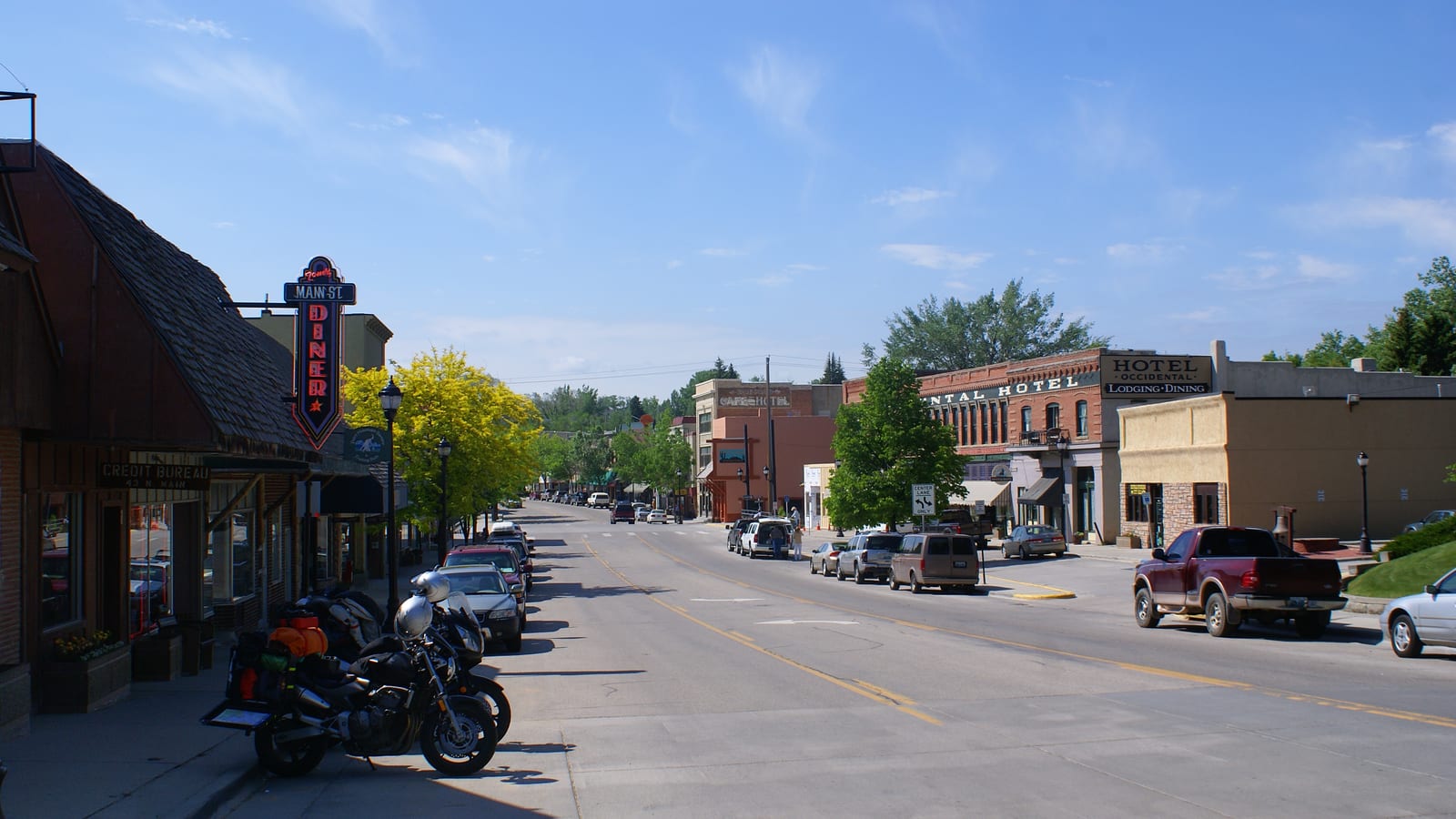
- Featured image: Ben Townsend from Blacksburg, Virginia, Buffalo WY - Main Street (Main Street, Buffalo, Wyoming), CC BY 2.0, via Wikimedia Commons, cropped.
RentDataNow publishes original research grounded in ZORI rent data, BLS wage data, HUD Fair Market Rents, and US Census demographics. Every study includes the underlying numbers, methodology, and sources so readers can verify or extend the analysis.
RentDataNow is an independent service and is not affiliated with, sponsored by, or endorsed by Zillow Group, Inc., the U.S. Census Bureau, the U.S. Department of Housing and Urban Development, or any government agency. ZORI (Zillow Observed Rent Index), the American Community Survey, Fair Market Rents, and other product names are trademarks of their respective owners, used here for identification only. Figures are provided "as is" without warranty of accuracy or completeness, and any reuse is at your own risk. See our Terms of Service for full terms.