

Most Rent-Burdened Cities in the US: 2026 Rankings
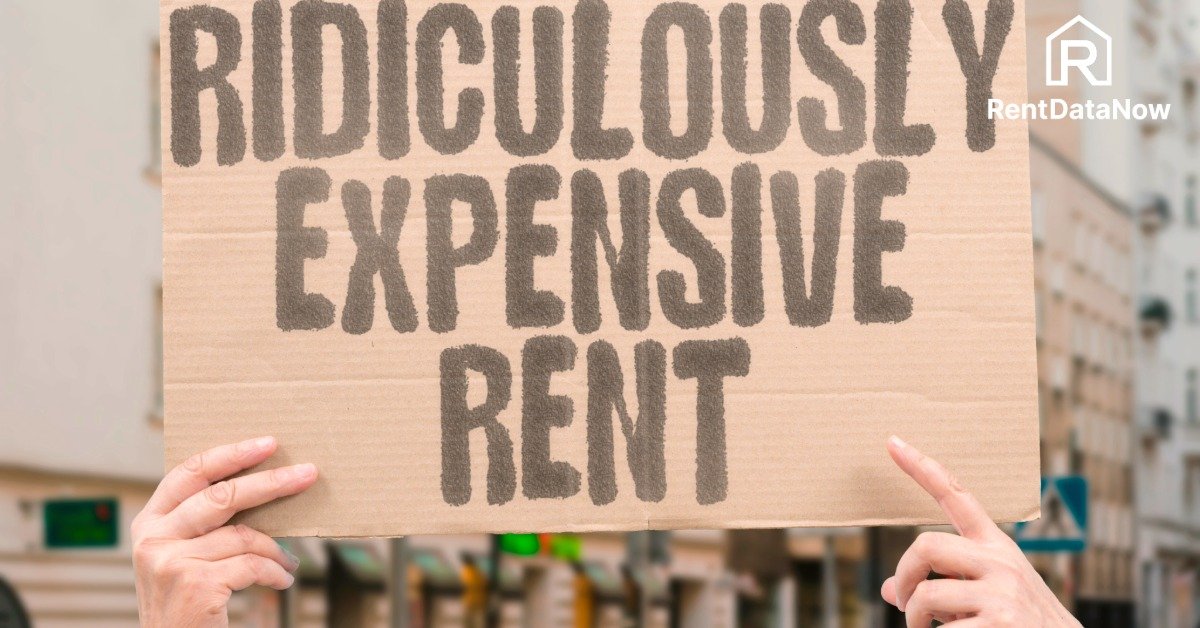
The Census Bureau defines a cost-burdened household as one spending more than 30% of gross income on rent. Severely cost-burdened is 50% or more. Those thresholds sound clinical until you start running them against actual cities, and then the numbers stop looking like policy statistics and start looking like a description of how people are actually living.
RentDataNow ranks 2,204 US cities by rent burden using live median rent and median household income data. What follows is a look at the cities sitting at the top of that list, what's driving the numbers in each case, and what distinguishes a city that's expensive from one that's genuinely extractive.
All data is from the RentDataNow rent burden rankings and reflects March 2026.
The Outlier at the Top
Hampton Bays, NY sits at number one on the list at 108% of median household income spent on rent. The median rent there is $12,075 a month against a median household income of $134,216 a year. Annual rent exceeds annual income. That is not a rounding error. Hampton Bays is a hamlet in Southampton on the East End of Long Island, and what the data is likely capturing is a market distorted by seasonal luxury rentals priced for summer visitors, not the working households who live there year-round. The income figure is the permanent resident median; the rent figure reflects a market that has largely decoupled from what locals can afford. It's an extreme case, but it illustrates something worth keeping in mind throughout this list: rent burden data shows where the math breaks down, but the reasons the math breaks down are different in every city.
South Florida Dominates the List
Florida places more cities in the top 50 than any other state, and most of them cluster around Miami-Dade and Broward counties. The pattern is consistent: modest incomes, rents that have been pushed up by years of migration pressure from the Northeast and Latin America, and a housing stock that was never built at the scale the demand required.
Gladeview, FL ranks second at 69.6%. Median rent is $2,753 a month against a household income of $47,469. Gladeview is an unincorporated community in Miami-Dade with a population of around 16,000, majority Black, majority renter-occupied, and essentially surrounded by a housing market that has priced out its residents without offering any viable path out. The rent is not $2,753 because Gladeview is a desirable neighborhood. It's $2,753 because the Miami-Dade market sets a floor that doesn't adjust for local wages.
Brownsville, FL is third at 66.8%: $2,272 median rent, $40,795 median income. Another Miami-Dade community, similar profile. Then Opa-locka at 6th (63.5%), Sweetwater at 16th (54.6%), Miami Gardens at 18th (52.9%), Hialeah at 20th (52%), and Miami proper at 12th (57.7% with a $3,001 median rent against $62,462 income). The concentration tells the story more clearly than any individual city does: this is a regional housing failure, not a series of isolated market quirks.
The full Miami-area picture, including neighboring cities with lower rents, is available through the RentDataNow compare tool.
The University City Problem
Several cities in the top 50 are not expensive in the traditional sense. They are college towns where the median household income is dragged down by tens of thousands of students earning little or nothing, while landlords price rentals for a market of 20-year-olds whose parents are paying.
West Lafayette, IN ranks fifth at 63.6%. Median rent is $1,848 a month. Median household income is $34,891, depressed by Purdue University's student population of 45,000 in a city of 45,000. The rent is not high relative to any major market. The income is just genuinely low because the people living there are students. The same dynamic drives Boone, NC (7th, 63.1%, home of Appalachian State), Ithaca, NY (35th, 48.6%, Cornell and Ithaca College), Oxford, OH (38th, 48.3%, Miami University), Kent, OH (46th, 46.4%, Kent State), and Blacksburg, VA (48th, 46.2%, Virginia Tech).
This is worth calling out because these cities are genuinely burdened in the sense that most residents are paying a high share of income on rent. But the policy response and the lived experience are different from a city like Gladeview or Camden, where low-income working families are being priced out of a regional market. In college towns, the burden is real but temporary for most residents.
The New Jersey Cluster
New Jersey places multiple cities in the top 35: Atlantic City at 14th (56.5%), Camden at 21st (51.5%), Passaic at 25th (49.8%), Newark at 29th (49%), Trenton at 32nd (48.9%), New Brunswick at 33rd (48.8%), and Lakewood at 34th (48.7%). Every one of these cities has a median income between $40,000 and $66,000 and a rent level between $1,739 and $2,676 that reflects proximity to the New York metro rather than local economic conditions.
Atlantic City is an interesting case. The casino economy has collapsed relative to its peak, the job market is precarious, and the median income of $41,028 reflects a city that lost its primary industry without replacing it. But the rent of $1,933 a month is set by a regional market that includes proximity to the Jersey Shore and the Philadelphia and New York commuter belts. The people who live in Atlantic City year-round are paying New York-adjacent rents on Atlantic City wages. That's a 56.5% burden ratio and no obvious path to improvement without structural change to the housing supply or the regional economy.
The High-Income Cities That Still Fail the Test
A few cities on the list are not low-income markets at all. Rancho Mirage, CA sits at 15th with a 55.2% ratio, but the median household income is $107,364 and the median rent is $4,938 a month. Marco Island, FL is 4th with a $101,523 income and a $5,440 median rent. Coronado, CA is 40th with a $134,534 income and a $5,349 rent. Kihei, HI is 37th with an $87,772 income and a $3,536 rent.
These are luxury or resort markets where the housing stock is priced for ownership and vacation use, and the rental market reflects that. A $5,440 median rent in Marco Island is not a symptom of renters being economically squeezed in the way a $2,272 rent in Brownsville is. It's a symptom of a market that was never designed for long-term renting. The burden ratio is high but the underlying situation is structurally different from a Camden or Opa-locka household where working families are simply trapped.
New York and New Haven: Large Cities With Nowhere to Hide
New York ranks 13th at 56.8%, with a $3,811 median rent and $80,483 median income. It's the largest city on the list by a wide margin at 8.4 million people, which means the aggregate number of severely cost-burdened households in New York dwarfs every other city on this page combined. The rent grew 7.93% year over year through March 2026, the steepest increase of any major city on the list.
New Haven, CT comes in at 47th with a 46.2% ratio: $2,189 median rent against a $56,851 median income. Yale University anchors the city's reputation but doesn't translate to broad wage growth for the non-university workforce. Lawrence, MA (39th, 47.8%) follows a similar pattern: a legacy industrial city in a high-cost regional market where the rents reflect Boston's gravitational pull and the wages reflect Lawrence's own economy.
What the Number Doesn't Capture
The rent burden ratio measures one thing: the share of median household income consumed by median rent. It doesn't capture how many people in a city are doubled up in apartments, sleeping on couches, or commuting 90 minutes each way because they can't afford to live near where they work. It doesn't capture the households paying 70 or 80% of income on rent because they fall below the median. The median-to-median comparison is the cleanest available data, but the actual distribution of burden within a city is typically worse than the headline number suggests.
The full ranking of all 2,204 cities is at rentdatanow.com/rankings/most-rent-burdened-cities. Each city on the list links to its full rent and income breakdown. If a lease is part of the picture, YourLeaseAgreement.com has state-specific agreements for every state represented on this list.
Frequently Asked Questions
What does “rent burdened” mean in housing?
A household is considered rent burdened if it spends more than 30% of its income on rent, and severely burdened at 50% or more.
Which U.S. cities have the highest rent burden in 2026?
Cities like Hampton Bays, NY and multiple South Florida communities top the list, with some households effectively spending over half, or even all, of their income on rent.
Are college towns really expensive or just appear that way?
They often appear more rent burdened because student populations lower the median income, even if rents aren’t unusually high compared to larger cities.
Related Rent Guides
How to Break a Lease Without Losing Your Deposit
Breaking a lease does not have to cost you your security deposit. Here is how to read your options, use your legal protections, an…

Why Every Rent Report Gives a Different Number, and Which One to Trust
One city, five rent reports, five different numbers. Here is what each major source actually measures, why they disagree, and whic…

Average Rent by State: From $1,206 in Iowa to $3,612 in New York
Rent varies nearly threefold across the US. Here is the average rent in all 50 states, from the cheapest to the most expensive, wi…

Henry Jo is a housing analyst covering rent data, affordability, city comparisons, and much more. He started following rental data while apartment hunting in two cities at once, and he lives in the Pacific Northwest.
Comments (0)
Sign in to join the discussion
No comments yet. Be the first to share your thoughts.